1945
Born in Maseno
Raila Amolo Odinga was born on 7 January in Maseno, the son of Mary Juma and Jaramogi Oginga Odinga.
Life & Legacy
Engineer, reformer, statesman and son of Kenya. His journey was inseparable from the nation’s pursuit of freedom, justice and unity.
His story
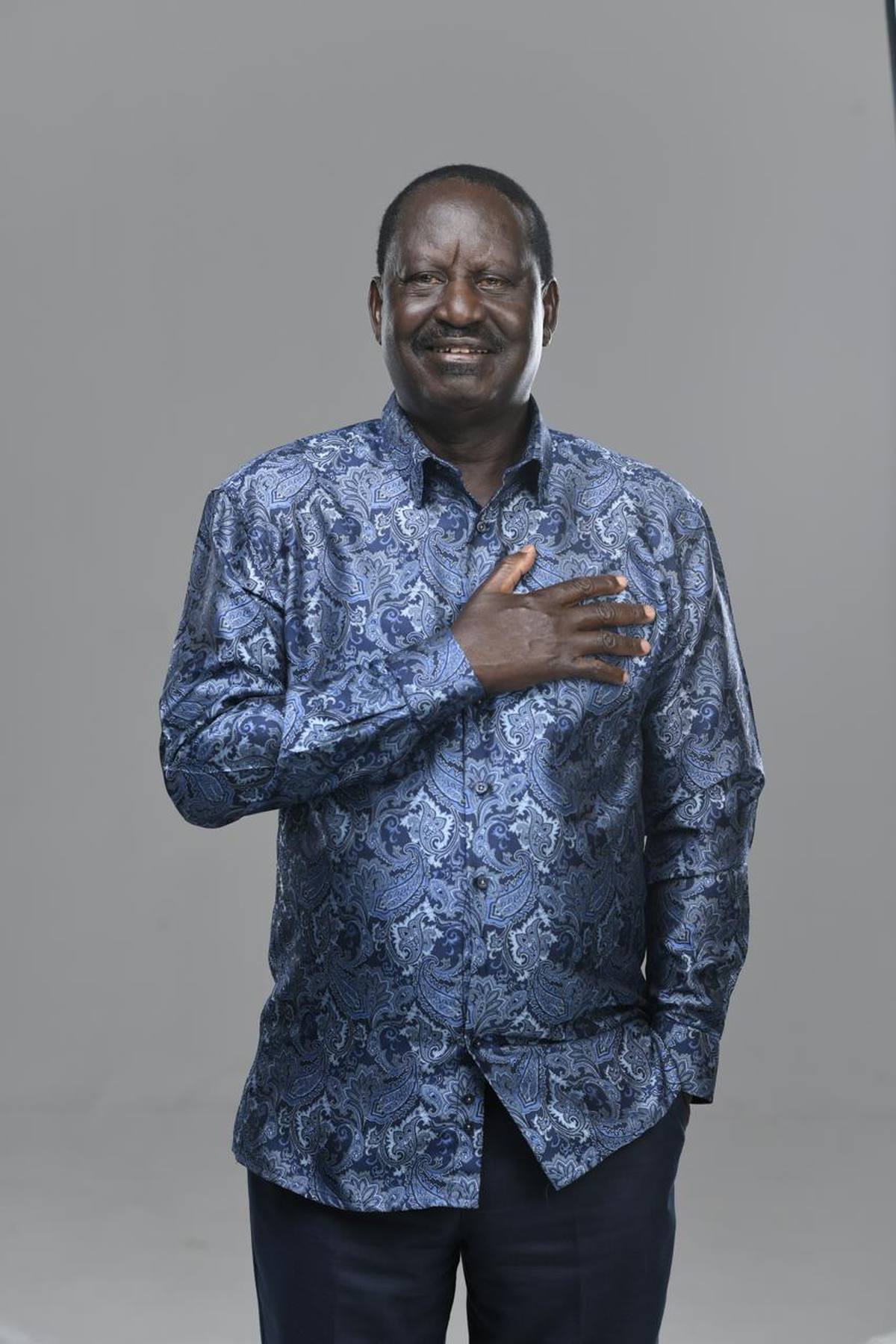
Rt. Hon Raila Amolo Odinga was born on January 7, 1945 in Maseno, in what was then the colony and Protectorate of Kenya. He was the son of Jaramogi Oginga Odinga, Kenya's first Vice-President after independence, and Mary Juma Odinga (also called Mary Ajuma). He grew up in a political and intellectually active household. His father was a prominent figure in Kenya's early post-colonial politics, which exposed Raila to ideas about governance, rights and dissent from an early age.
Hon Raila began his schooling at Kisumu Union Primary School, then attended Maranda Primary and later Maranda High School in Bondo, Siaya County.
Around 1962, he left for East Germany to further his studies. He joined the Herder Institute (part of the Philological Faculty, Leipzig) to study German, before undertaking Technical Studies in Magdeburg. In 1970, he obtained a degree in Mechanical Engineering (Diploma, equivalent to a Masters-level degree) from the Technical University/Institute in Magdeburg.
After returning to Kenya, he taught at the University of Nairobi's Mechanical Engineering Department until 1974. Later, he joined the Kenya Bureau of Standards (KEBS) and rose to become Deputy Director in 1978.
Hon Raila's political activism became more pronounced in the 1970s and 80s. He opposed the one-party dominance under President Daniel Arap Moi and pushed for reforms.
In 1982, he was accused of participating in a failed coup attempt and was imprisoned without trial from 1982 to 1988. After release, he was detained again multiple times in the late 1980s and early 1990s for his pro-democracy activism. In 1991, facing threats to his safety, he went into exile (political asylum) in Norway.
He returned to Kenya in 1992 and joined the Forum for the Restoration of Democracy (FORD–K), his father's political party and was elected Member of Parliament for Lang'ata Constituency.
After the death of his father in 1994, a leadership struggle ensued within FORD–K. Hon Raila eventually moved to the National Development Party (NDP). In 1997, he ran for President as NDP's candidate, coming third after Moi (KANU) and Mwai Kibaki (Democratic Party), but retained his Langata parliamentary seat. His NDP and KANU, the then ruling party, joined forces and he was appointed Minister for Energy in 2001.
In the 2002 elections, he helped form the National Rainbow Coalition (NARC), which defeated KANU. He served as Minister for Roads, Public Works and Housing from 2003 to 2005.
Hon Raila contested presidential elections five times, in 1997, 2007, 2013, 2017 and 2022. In the 2007 election, his loss to Mr Kibaki was disputed, leading to violent unrest across Kenya. A political resolution mediated by former UN Secretary General Dr Kofi Annan led to a Coalition Government where Hon Raila was appointed the Prime Minister on April 17, 2008.
He served as Kenya's Prime Minister from 2008 to 2013, under a power-sharing arrangement with President Kibaki. After the position of Prime Minister was abolished under the 2010 Constitution, he continued as a key Opposition figure. He remained active in politics, contesting further elections and being involved in party coalitions through his Orange Democratic Movement (ODM). The coalitions are CORD, NASA and Azimio la Umoja. He also took on continental and international roles, including the African Union High Representative for Infrastructure Development.
The former Prime Minister was married to Ida Odinga (née Anyango Oyoo), and together they had four children (the late Fidel, Rosemary, Raila Jr and Winnie). He became known to many Kenyans as "Baba" (meaning "father"), and was a master orator gifted with exceptional mass mobilisation and political organisation abilities. His political life was marked by persistence, defined by decades of resistance, detention and exile and unrelenting push for constitutional reforms.
Hon Raila succumbed to cardiac arrest on October 15, 2025 in Kochi, India where he was undergoing medical attention.
Milestones
1945
Raila Amolo Odinga was born on 7 January in Maseno, the son of Mary Juma and Jaramogi Oginga Odinga.
1970s
He returned from engineering studies in Germany and went on to teach at the University of Nairobi.
1982–91
He endured years of detention without trial while pressing for political reform and multiparty democracy.
1992
He entered Parliament as the Member for Lang’ata, beginning two decades of parliamentary service.
2008
He became Kenya’s second Prime Minister under the National Accord, serving until 2013.
2018
The handshake of 9 March opened a new chapter of national dialogue and reconciliation.
2025
He died on 15 October at the age of 80, leaving an enduring national and continental legacy.